
The Insides Driver is unable to handle very thick viscosities of chyme; however, The Insides Port is available to dilute chyme to a more manageable viscosity for the Driver to reinfuse. Please refer to The Insides® System Instructions for Use, The Insides Port Instructions for Use, and Patient Management sections in the training hub.
As a general guide, an output over 1 Litre/24 hr should be thin enough to reinfuse. If the patient’s chyme is consistently too thick, daily use of The Insides Port in combination with the following measures will thin the chyme to a manageable viscosity. This may include:
• Weaning anti-motility medication
• Drinking one to two extra glasses of water
• Drinking one to two cups of coffee
The Insides Driver does not have a flow rate because chyme is made up of fluid and particles. Very thin/water like chyme will be reinfused quicker in comparison to thicker chyme. Thicker chyme will take longer because the Pump complex needs to grind the particles to generate enough pressure to move it up the Tube. It is best to chew food well so there is less work for the Pump. Use the lowest speed that moves chyme up the Tube to reduce patient discomfort and reflux. An ostomy appliance holds 200-300ml of chyme, this can usually be pumped through in under 5 minutes.
The patient changes The Insides Pump every two to three days along with their usual ostomy appliance change.
My patient does not have good dexterity to hold The Insides® Driver, what is an alternative?
• Ask a family member/carer to assist the patient with reinfusing their chyme.
Swivel the pump around, so the flat surface is facing the back of the ostomy appliance. Then rest The Insides Driver up-side-down on their lap and couple The Insides Pump on top. Ensure the front panel of The Insides Driver can be seen by the patient or carer. Position the ostomy appliance so that gravity keeps the chyme sitting on top of The Insides Pump. Get the patient or carer to press the chyme onto The Insides Pump if necessary.
Most patients hold The Insides Driver with their dominant hand, with the front panel facing up so they can see it and are able to press the “Mode” button to move through the speeds. Their non-dominant hand holds the back of the ostomy appliance, “cupping” the chyme and pressing it into the back of The Insides Pump. When “cupping” the chyme, ensure the patient uses the flat of their hand to press into the back of The Insides Pump so there is no risk of cutting or crushing of fingers from the macerator within The Insides Pump. Use gravity to assist with keeping The Insides Pump submerged in the chyme. Encourage your patient to find a position that is comfortable and efficient for them.
The Insides Pump should intuitively fit into the hold at the back of the Insides Driver. The Insides Driver and The Insides Pump should be coupled first, before pressing the ‘Mode’ button to initiate chyme reinfusion.
Blocked Pump – Try the following Troubleshooting Tips to unblock The Insides Pump otherwise, change The Insides Pump. To stop The Insides Pump from blocking, stop eating stringy fibrous food which blocks The Insides Pump.
• The Insides® Pump – Ensure The Insides Pump is fully submerged in the chyme.
The Insides® Driver – Ensure all speeds on The Insides Driver have been tried for a minimum of 30 seconds each, to ‘pump’ the chyme up The Insides Tube. Sometimes the thicker chyme viscosity’s move slowly up The Insides Tube.
Not coupled correctly – Ensure the flat surface of The Insides Pump has been cleared of debris and intuitively couple The Insides Driver with The Insides Pump through the ostomy appliance. Carefully hold The Insides Driver up and The Insides Pump should remain coupled. This demonstrates they are coupled effectively.
• The Insides Driver bounces off The Insides® Pump – This can happen at speed 5 or if The Insides Pump is blocked.
Tube not anchored below the fascia – The bulbous anchor may have slipped underneath the fascia. The patient may be in discomfort or you will see an increased length of tube in the ostomy appliance that could indicate it has slipped out. If The Insides Tube is not intubated correctly, there will not be effective chyme reinfusion.
Chyme is water thin, I have tried everything, but it is still not pumping – This may happen with a balloon retained tube. A bubble of air may be trapped within the tube, creating an airlock. ‘Milk’ the tube by pinching and folding the tube to break the air bubble. This may need to be done several times. Manipulate the tube in and out about 1cm to ensure free movement of the tube.
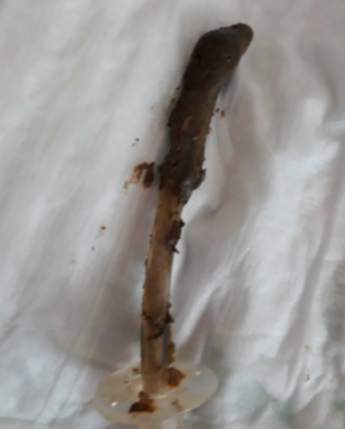
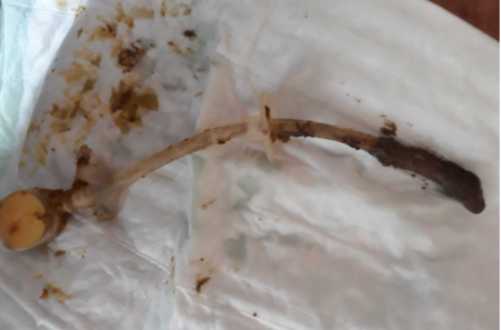
Stool on the tip of the tube – If The Insides Tube or balloon retained tube is showing an increased length of tube in the ostomy appliance and it is not painful for the patient, but chyme is not transiting though the tube, there could be stool coating the tip of the tube. See images below. This may happen due to the patient not having effective bowel preparation before surgery or high levels of anti-motility medication. Inserting a new tube is recommended.
Drivers are Single Patient Use only and must not be used with more than one patient for regulatory, and health and safety reasons. Please dispose of The Insides Driver upon the reversal of the patients enterostomy or fistula according to the local disposal authority. Please refer to The Insides System - Instructions and Technical Description contained in the packaging for further guidance.
It is very unlikely the ostomy appliance however, if this occurs, please contact The Insides Company Clinical team to resolve.
Sometimes a patient with a very high output who is reinfusing over 10-12 times per day may cause a tiny hole to appear in the plastic of the ostomy appliance directly in front of where The Insides Pump sits within the appliance. This mostly occurs because The Insides Pump is not primed with chyme i.e. there is no chyme in the ostomy appliance while The Insides Driver is coupled and working. This could also occur because The Insides Driver connects in the same spot every time and through the vibrations and possible friction moulding that could occur, a hole may appear. Cover the area on the ostomy appliance with a small piece (2cm x 2cm) of hydrocolloid to improve the integrity of the plastic.
There is a safety mechanism in place that if The Insides Driver runs completely flat it will not recharge on a single charge. We recommend the Driver is charged for two (2) hours every week to ensure it doesn’t run out of battery. If the Driver runs flat:
• First ensure you are using the correct wall charger. The Driver only charges with its own charger
• Connect it to the wall charger and wait for approximately 15 minutes for the lightning bolt to flash on the front panel.
• Disconnect it, wait 1 minute and reconnect to the wall charger.
• Repeat step 1 and 2 several times until the Driver can hold a charge and completes a full charge.
• If this does not charge the Driver, please contact your local distributor or The Insides Company.
A healthcare professional appropriately trained in intestinal intubation must always insert The Insides Tube. The Insides Tube gets replaced every 28 days.
The bowel length, that is external to the fascia, can be kinked and lengthened with a parastomal hernia. Caution is required when intubating a patient with a parastomal hernia. Digital palpation is required to gauge length, kinking or narrowing and direction to safely intubate the distal limb of the enterostomy. If there is any resistance or pain for the patient, they are unsuitable for chyme reinfusion. If digital palpation does not identify any concerning features of the hernia, then careful intubation by a trained health care professional is recommended. It is recommended that a balloon retained tube be used rather than The Insides® Tube in this instance.
There are 3x Insides Tubes provided in The Insides System to help mitigate any tubes falling it. It is expected that the tube will fall out at least once in the first week.
There are 3 possible reasons for this:
The patient accidentally pulls it out when they change their ostomy appliance.
Peristalsis is pushing the tube out. The Tube usually stays in for 1- 2 days and then spontaneously slides out. Encourage the patient to hold Tube retention sleeve when reinfusing and walking around. After the first week, this should stop because true peristalsis has been re-established. The Insides Clip will assist with this.
The surgical cut in the fascial layer, where the proximal and distal end is brought through, is too wide to retain the bulbous feature of Tube, so it just slides out. The Insides Clip will assist with anchoring it in place. However, please talk with The Insides Company Clinical team if this continues.
If the Insides tubes keep falling out, we suggest trying a balloon retained feeding tube.
If all other resolutions fail, another option to keep the Insides tube in situ is to use a second convex ostomy appliance, placed back to front, directly over the primary ostomy appliance that is secured with an stoma belt. Placing an entire ostomy appliance over removes pressure points and offers a wide surface as a “back-stop” to keeping the Tube in place. An example:
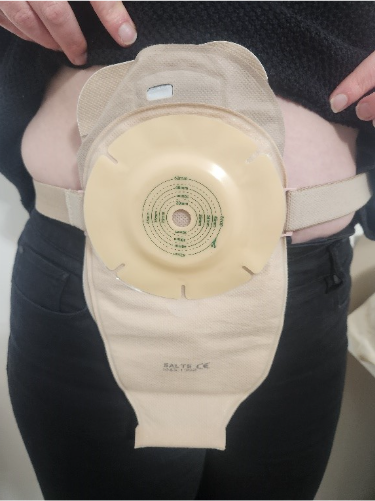
If you are unable to insert The Insides Tube either 28 Fr or 22 Fr – ultimately this should be highlighted at the time of the contrast imaging, assessing the distal bowel for chyme reinfusion. The likely causes for not being able to insert the Tube are the following:
Narrow fascial opening – this will likely need interventional radiology/endoscopic insertion. Careful consideration in respect to the space that is available in the fascial opening needs to be observed. The proximal and distal limbs plus the tube placed downstream need to fit comfortably without causing any blood flow obstruction and compromise to the stoma. Once the tube is placed, if stoma colour changes, or other obstructive signs are noted, immediately remove the tube. This patient is not suitable for chyme reinfusion with The Insides System
Kink/stenosis/narrowing of the bowel immediately below the fascia - this will likely need interventional radiology/endoscopic insertion. Placing a tube may straighten out the bowel so that interventional radiology is not required next time. A smaller non-Insides tube maybe required. If this is not the case, interventional radiology will need to be used each time to replace the tube.
Atrophied distal bowel - Gentle dilation with warm water and a small-bore Foley catheter to start to rehabilitate the distal bowel is helpful to be able to introduce a distal feeding tube. Depending on the level of atrophy you may be able to insert a Tube the same day or repeat over multiple days to reach a point where a 20 or 22 Fr Tube can be installed downstream.
If the patient has an enterocutaneous fistula (ECF), please consult with The Insides Company’s stomal therapist for an individualised solution.
It is known that pouching a patient with an ECF can be extremely difficult and distressing for the patient. It requires trial and error with many products and techniques in order to protect the peri-fistula skin and direct the flow of chyme into the ostomy appliance.
Things to consider:
• Reflux – A constant flow of chyme over the hydrocolloid at the aperture of the ostomy appliance will degrade the hydrocolloid quickly and cause leaks. Review the cause of reflux.
• Reduce the speed of the Insides® Driver to reduce reflux.
• Reinfuse smaller and more frequent boluses to reduce reflux.
• Is it temporary and will resolve once the gut has rehabilitated?
• Is the patient constipated?
Due to the undulating abdominal landscape, accessories such as hydrocolloid seals and paste are strongly recommended. Consider building up the seals to increase absorbency and reduce the deterioration of the seal.
Chyme viscosity – Water thin chyme not only increases the risk of dehydration but also the risk of the chyme sliding underneath the aperture of the ostomy appliance and creating a leak. Consider thickening the chyme via anti-motility medication to reduce this risk. However, the thickness of chyme must remain within a normal range to reinfuse. Anti-motility drugs can also cause constipation downstream of the stoma.
Retention sleeve – Does the retention sleeve on the Tube get caught on the aperture of the ostomy appliance? Lift the tube into a horizontal position when threading the ostomy appliance on. This ensures the retention sleeve clears the edge of the ostomy appliance and sits completely inside the pouch.
Night bag – To stop chyme pooling at the aperture of the ostomy appliance, attach a night bag to the end of a high output drainable ostomy appliance. This creates a vacuum and draws the chyme away from the aperture. If this option is used, ensure the patient is wearing a 2 piece or an ostomy appliance with a window so chyme can be transferred back into the pouch to be reinfused.
• Ostomy appliance – Ensure all recommended manufacturer’s guidelines are being followed when applying the ostomy appliance. An example of this is warming the hydrocolloid before application.
Can I use a night bag attachment to capture my night-time output?
Yes, but you must complete the following steps to do it safely. Please refer to the Patient Management section in the training hub.
• Reinfuse all chyme sitting in the ostomy appliance immediately before attaching the night bag.
Take any short-acting medication at least four (4) hours before attaching the night bag. This ensures the medication has been digested and reinfused before the night bag has been attached so there is negligible medication sitting in the night bag.
Chyme sitting in the night bag must be reinfused within twelve (12) hours. For example, if the patient attaches the night bag at 10pm they must reinfuse what is sitting in the night bag between 9am – 10am the next day. If chyme sits in the ostomy appliance for longer than twelve (12) hours, it should be discarded.
Please refer to Prior to reinfusing with The Insides System. A patient can resume chyme reinfusion if a feeding tube can be safely placed back in the distal limb, please consult with The Insides Clinical team prior to the attempt.
A prolapsed limb (proximal, distal or both) is an inherent risk of having a stoma or fistula due the intestinal limbs being brought through the abdominal wall. They can occur spontaneously or with a sudden increase in intra-abdominal pressure such as coughing or lifting. The prolapsed limb can generally be reduced by a trained healthcare professional in a colorectal specialty if attended to within 24 hours of occurrence but the risk of it prolapsing again is high. When a prolapse occurs closer to the expected closure surgery timeframe this is generally regarded as a good sign that inflammatory adhesions have reduced or resolved so it is safe to re-enter the abdomen.
If a patient’s ostomy appliance or fistula wound bag is not lasting at least 24 hours or requires low wall suction to prevent chyme from constantly leaking under the base plate- Do not start The Insides System until the pouch consistently reaches at least 24 hours, this is to reduce the burden of change and consistently losing chyme to pouch leaks that cannot be reinfused. Factors to consider:
• Active intervention from the stomal therapy nurse or wound care to optimise the pouch.
• Generally speaking, the stoma or fistula needs to mature a little more (and the fistula wound needs to heal more) to assist with bag adhesion.
If a fistula has a large deficit in which the chyme pools, especially when the person is lying flat, this could be an occasion to use low wall suction to draw chyme away. This is beneficial from the point of view of keeping the stoma pouch or fistula wound pouch intact however, it restricts the patient’s movements. Consider a VAC dressing on the fistula wound during this time as well to speed up healing.
Consider during this time to preserve a 200ml bolus of chyme daily that can be manually reinfused downstream to begin rehabilitating the distal bowel and provide consistent enteric content for luminal health. This can be completed at a suitable time of day when the wall suction is turned off for 20-30 minutes to administer the bolus. Like a 2pm at shift change over.
Patients with poorly sited stomas (in abdominal creases, under ribs, out of the patient’s line of sight, retracted and/or stenosing stomas) and with short stoma bag adhesion time (less than 24 hours before leaking) are not considered good candidates to undertake chyme reinfusion with The Insides System. If the stoma can be re-located or re-fashioned so it protrudes to create a longer appliance wear time, then chyme reinfusion can be reconsidered. The fatigue and burden of changing the ostomy appliance so frequently, coupled with the wasted chyme lost to appliance leaks, negates any meaningful use of the device.
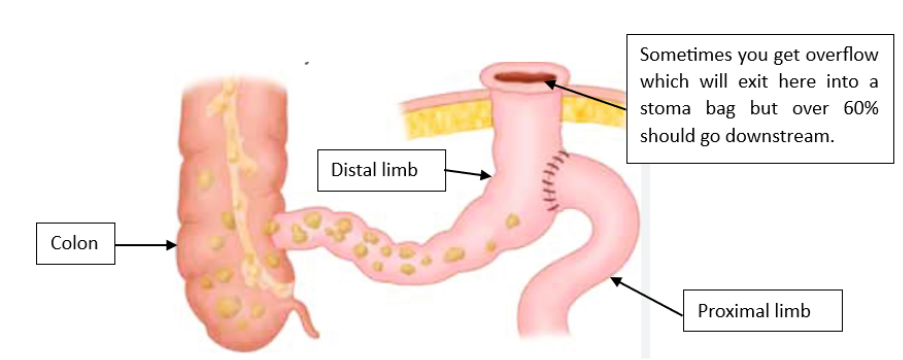
If a patient has a Bishop Koops stoma, The Insides System will likely not work because the tube will occlude the only outlet where chyme exits into the ostomy appliance. Manual chyme reinfusion will likely work because the tube is removed each time a bolus is completed. When placing a tube for manual bolus chyme reinfusion there may be a requirement to use interventional radiology to place the tube which negates regular use of chyme reinfusion. Surgical planning with appropriate stoma formation preparation for chyme reinfusion therapy is vital for to the success of commencing chyme reinfusion therapy with The Inside System. Picture of a Bishop Kops stoma illustrating why The Insides System is not compatible with this type of stoma:
Please refer to the Patient Management section in the training hub.
Reflux is not harmful to the patient but it does increase the length of time taken to reinfuse their chyme.
Reflux could happen:
High speed – A thin viscosity chyme, reinfused at a high setting on The Insides Driver will cause reflux and increase the time taken to reinfuse. The Insides Driver should be set at the lowest speed that moves the chyme through The Insides Tube.
Constipation – The patient may be constipated from high dose anti-motility medication. The anti-motility medication needs to be weaned to reduce this. The distal bowel needs to be cleared for effective chyme reinfusion to occur.
Atrophied distal bowel – The distal gut needs to be rehabilitated slowly. The patient will experience more reflux in the beginning because the luminal walls need to expand and rehabilitate. Small boluses regularly throughout the day will achieve this and reduce the reflux.
Please refer to the Dietary Guidelines contained within the Patient Guide to Chyme Reinfusion Therapy in the training hub. The dietary information pertains to use of The Insides System, it does not provide general patient dietary information.
Thin ‘stringy’ fibrous food gets caught in the back of The Insides Pump which reduces effective pumping. Avoid or blend fibrous food to ensure more effective chyme reinfusion.
Please refer to The Insides System Instructions for Use and Patient Management sections in the training hub.
Rehabilitating an atrophied distal gut and initiating chyme reinfusion stretches the luminal walls of the intestine. This stretch can generate a diffuse abdominal discomfort, nausea, and bloated feeling for the patient. The longer they have been defunctioned, the increased level of atrophy and subsequent symptoms the patient will experience. Following the provided guideline on increasing tolerance will reduce the symptoms for the patient, ensure patient compliance, and rehabilitate the patient’s gut within one to three weeks. Once the gut has been rehabilitated, these symptoms should resolve.
While the patient is increasing their tolerance to chyme reinfusion, there will be chyme discarded directly from the ostomy appliance. These net losses can be recorded on the Patient refeeding record or The Insides System Patient Log Book. As the distal gut rehabilitates, there will be reduced net losses and more bolus chyme reinfusion. Once the distal gut has been rehabilitated, the patient should be reinfusing as much of their output as they can.
A common side effect of chyme reinfusion is the discomfort, nausea, and bloating felt in the first week. This soon resolves once the gut is rehabilitated.
Yes, please refer to the Suggested Chyme Reinfusion and Parenteral Nutrition Weaning Guidelines document.
No, nothing should be added to a patient’s ostomy appliance to reinfuse. Only intestinal content that naturally passes into the patient’s ostomy appliance should be reinfused except for water during the initial testing.
Please advise the patient that rehabilitating their distal bowel will likely be an uncomfortable experience, but it will be managed slowly, and discomfort kept to a minimum. Please reassure your patient that the discomfort will pass once their bowel is rehabilitated.
Please refer to Please refer to The Insides® System Instructions for Use and Patient Management sections in the training hub. Reinfuse 50ml of chyme once daily and very slowly increase the frequency to their tolerance. This may take up to three (3) weeks.
• If chyme starts moving up the Tube on speeds 1 – 3, approximately 50 ml would be reinfused in 15 seconds.
• If chyme starts moving up the Tube on speeds 3 – 5, approximately 50 ml would be reinfused in 30 seconds.
• It is recommended to start with The Insides Tube 22 Fr for the first 28 days before moving onto The Insides Tube 28 Fr.
Do not start weaning off anti-motility medication and having large meals until the patient is sufficiently rehabilitated. This is to mitigate increased output into the ostomy appliance and increasing the risk of dehydration.
Please refer to the Patient Management section in the training hub and this question, Can I use a night bag attachment to capture my night-time output?
Please refer to Prior to reinfusing with The Insides System on the training hub. This may lead to some mild constipation initially, but this can be managed with a powdered osmotic laxative and/or enema to resolve the constipation (please reach out to the clinical team for more information). Once the patient is independent with The Insides System and reinfusing most of the chyme, start to wean off PN and anti-motility medication. Chyme reinfusion re-engages of entero-physiological processes (including enterohepatic recycling and the ileal brake), which reduces gastric secretions and can increase oral medication absorption. For more information, please read the blog How chyme reinfusion therapy restores enterohepatic recycling, reinstates the ileal brake, and alters drug absorption
Please refer to Patient Management on the training hub and this question - What do I do about reflux?
Antimotility medication can cause constipation downstream, causing more reflux. Clinically assess for constipation and adjust the dose of antimotility medication as required. Clinically assess requirement for aperients and contact The Insides Company Clinical team for administration guidance.
Unless advised by the surgical team, the patient can reinfuse their chyme to the day of surgery.
My patient was on a continuous enteral feed distally prior to starting The Insides® System but they continue to be very uncomfortable, even after 2 weeks of use
The continuous enteral feed was trickling into the distal limb at a consistent rate which simulates normal peristaltic movements and doesn’t stretch the luminal walls like a bolus administration of chyme with The Insides Driver does. There will be a period of adjustment for the distal intestine to become accustomed to a bolus of chyme but this will likely resolve within the first week due to the prehabilitation from continuous enteral feed. If there is still pain or discomfort after 2 weeks, assess and find cause. There maybe be an unidentified obstruction/narrowing/stenosis that spontaneously occurred. Previous surgery that resulted in an anastomotic join distally may have contracted during healing that is causing pain or discomfort that was not previously identified due to the administration switching from continuous to bolus.
It is best to start chyme reinfusion therapy as soon as possible, generally 2 weeks after stoma forming surgery and when the distal outlet of the enteroatmospheric fistula has matured to fit the feeding tube (approximately 8-12 weeks from first appearance). By commencing the therapy as early as possible:
• The risk of atrophy of the distal intestine is reduced,
• The distal intestine is rehabilitated and maintained for longer,
• The patient learns to manage their stoma or fistula at a similar time to tube and pump management. This is not such an onerous task in comparison to someone that has been independently managing their ostomy for months
The reason for the high goal of reinfusing the gastric secretions/output will guide whether this is appropriate.
• If the patient has a post-operative ileus, reinfusing gastric secretions would distend the bowel further
If it is due to a gastric outlet or duodenal obstruction and the distal feeding tube or feeding jejunostomy is distal to the obstruction, yes this would be helpful to reinfuse the gastric secretions to assist with nutrient absorption in the remaining small bowel.
Yes, you can for the hydration benefits. However, the proximal outlet must originate in the small bowel, so chyme is the right viscosity to reinfuse. It is best if the distal colonic outlet originates from the ascending colon to maximise the hydration benefits and reduce the incidence of loose stool being passed rectally. Please refer to the The Insides® System Instructions for Use on tube insertion.
Caution is required when testing the function of a patient’s J pouch or ileal pouch-anal anastomosis (IPAA). The patient needs to be made aware of the effect of bolusing chyme into a J pouch. Reinfuse a small amount of chyme at a low speed.
Yes, you can but please consider the following:
• The output that is being reinfused must be chyme, originating from the small bowel so the viscosity will work with The Insides System.
• What is the goal?
• For preservation of the out of circuit intestine that will not be resected at the time of reversal?
• Maximising nutrition?
• Maximising hydration, or both?
• Does the patient have the dexterity, enthusiasm, and family/friend support to manage two tubes, and thus two bolus reinfusions?
Guidance around manging two (or more) reinfusions systems:
• Focus should be placed on reinfusing the most proximal distal limb to ensure maximal absorption of nutrients.
• Introduce the second reinfusion once the patient is confident with the first. This must be a slow methodical titration to ensure the patient is coping.
• Provide support around ostomy appliance changes until they are independent and confident
• If the second double barrel/fistula outlet (distal to the first) is located in the distal jejunum/proximal ileum, reinfuse as often as possible into this distal limb as well.
If the second double barrel/fistula outlet (distal to the first) is located in the distal ileum/ascending colon, reinfuse chyme into this distal limb as much as clinically indicated to ensure nourished and hydrated (This may mean onl7 2-4 times per day)
Once the terminal ileum is back “in circuit”, a patient’s output will thicken up considerably so ensure the patient knows how to thin their output, wean off anti-motility medication and perhaps reduce reinfusions to twice a day (discarding thick output that cannot be reinfused).
• Follow up with the patient regularly to ensure they are managing well. Pause reinfusing the second distal outlet if there are concerns around coping and restart once the patient is ready.
• Regularly reassess the goals of reinfusion.
Please refer to the Patient Evaluation Checklist. If the indication for chyme reinfusion is to:
• Increase absorption of calories and fluids
• If the colon is in circuit, a short segment of 15-20cm of ileum is adequate. This is also to avoid any interaction between the tube and the ileocaecal valve.
• If the colon is absent, a segment if 30-40cm of ileum is adequate to an end ileostomy
• Increase absorption of fluids and electrolytes
• Refeeding directly into the ascending colon is acceptable, but it is preferable to have at least 15-20 of ileum to reinfuse into first.
Yes, you can. Nutrient absorption can be maximised by reinfusing the same chyme 2-3 times before discarding it. This chyme is still not classed as waste. The length of bowel is short so there is not enough bowel length available for maximal nutrient absorption the first-time round. Optimise nutrient absorption by reinfusing it 2 or 3 times and then discarding.
The patient needs to be reviewed by their surgical team as to the cause of the issue.
The Insides System has not been tested above that height, so it is not indicated to be used above 3000m.
EAF patients have tenuous anatomy and likely friable tissue with a high risk of herniation and/prolapse. The distal outlet is generally narrower because it is a perforation of the bowel. There is also generally no fascia to anchor the tube behind so it needs to be advanced further to maintain stability of the tube better.
The tube that is used for chyme reinfusion may change over the course of the patient's rehabilitation as the wound begins to heal. Any balloon retained tube that has a funnel end so that The Insides Pump can slide onto the end of it can be used. Please refer to Gastrostomy Tube Insertion Guideline and Cook Entuit 24Fr Tube visual guide for guidance on insertion and use.
A 2-way 22 Fr Foley tube reinfuses chyme more efficiently than a 3-way 24 Fr Foley. You can spigot the irrigation line of the 24 Fr Foley however, there is a pressure reduction and The Insides Driver needs to work harder to move chyme up this tube.
• A 24 Fr Cook or Halyard gastrostomy tube is best if this is what is available to you because you don’t have to coil so much of the tube within the ostomy appliance.
Bile reinfusion is possible. The likely and preferred abdominal set-up is:
• person is nil by mouth
• a percutaneous drain in the bile duct draining bile,
• a mucous fistula/distal limb/feeding jejunostomy end stoma (no proximal outlet))
The patient is likely receiving enteral nutrition directly into the mucous fistula/distal limb/feeding jejunostomy end stoma. To optimise lipid breakdown, re-engage enterohepatic recycling and the ileal brake, bile should be added to the enteral nutrition/distal tube feeding the mucous fistula/distal limb. Expected bile output per day is between 200 mL – 1000 mL, the volume will direct the best course of action.
If their bile output is less than 500 mL per day, place an ostomy appliance over the percutaneous tube to collect the bile output. Drain the bile into a cup and perform a manual bolus of bile into the distal feeding tube (down the medication port). Since the volume is so low, this may only be required 1-2 times per day.
If their bile output is more than 500 mL per day, place a neonatal ostomy appliance with The Insides Neo assembled in it (Hollister 3778 or Coloplast 18700) over the percutaneous tube to collect the bile. A neonatal ostomy appliance holds approx. 50-100 mL so set the frequency of bile reinfusions to volume output. Couple an ENFit syringe to The Insides Neo Adaptor and withdraw bile. Then place the syringe in a syringe pump with extension set and set rate to reinfuse into the medication port of the distal feeding tube placed in the distal limb/mucus fistula. Fresh bile will collect in the neonatal ostomy appliance while the continuous bile reinfusion is running.
A patient that has a high output stoma or fistula who has been palliated could be a good candidate to send home with chyme reinfusion therapy. This provides them the opportunity to adequately manage their hydration levels but more importantly to spend their final days at home with family and friends rather than in hospital.
Please refer to Prior to reinfusing with The Insides System on the training hub.
No, we have not receieved any feedback from customers regarding this. We do strongly recommend clinicians read and understand The Insides System - Instructions for Use and the documents contained on the training hub prior to starting the device with their patient.
What is the concern directly relating to?
• Having a tube in situ consistently with concern around being able to undertake activities of daily living?
The only way to know for certain is to place the Tube and monitor and support the patient to work with this. Slight modifications to bodily movements may need to occur. For example, bending over to tie a shoelace; the patient may need to place their foot up on a bench to tie the shoelace.
• Access to the distal outlet is narrow
Digital palpation is recommended first. If the smallest finger is unable to be inserted downstream, dilation of the stoma outlet by a healthcare professional appropriately trained in intestinal intubation is reasonable so that a suitable sized tube can be fitted for the patient. We recommend dilating up to a 20 Fr tube so that it is large enough to fit viscous chyme. The next time the tube is changed, do assess to see if rehabilitation of the distal limb has increased the calibre of the outlet so The Insides 22 Fr Tube is now able to fit.
• There is a kink (that does not have an Inflammatory Bowel Disease aetiology) in the intestine, close to the distal outlet, that may not be able to be navigated around with the tube.
Cautious clinical assessment is required, if safe to proceed, there are two options:
Place a smaller bore tube downstream that can navigate around the kink. Keep this in situ for several days and manually reinfuse saline to assist with increasing the calibre of the distal limb. Attempt a larger bore Tube after this time.
Endoscopically place the Insides tube or balloon retained tube that is 20 Fr or larger and keep in situ for 28 days. The tube will likely ‘straighten’ this portion of intestine so bed side installation of the Tube is achievable next time.
Please present this information to the patients Cardiologist to evaluate if they are eligible:
The device passes the EMI standard for a medical electrical device IEC60601-1-2. But it also has strong rotating permanent magnets (rotate from 0-5000 rpm). These permanent magnets are not specifically evaluated under this standard.
We have completed studies on bacteriology in chyme within a stoma bag and the results have shown that the bacteria that is naturally in chyme, does not multiply or colonise the stoma bag. In a person with no stoma or fistula, these bacteria would just continue to transit through the intestine. There have been no reports of infection in the time that The Insides System has been available nor any reports in global literature reviews of infection since the inception of chyme reinfusion therapy in the 1970’s. Further to this, The Insides System performs chyme reinfusion therapy within a closed circuit, further reducing this risk.
There are 2x 28 Fr tubes and 1x 22 Fr tube supplied.
These clips provide further securement of The Insides Tube. The Insides Clip is placed on the outside of the ostomy appliance, over the Tube (think of a clothes peg), and sits as close to the bottom of retention sleeve as possible. How to use The Insides Clip and Applying The Insides Clip video can be found on the training hub. The Clips are colour coded:
• Purple Clip can be used on the 28 Fr and the 22 Fr Tube and is placed on the widest part of the tube (this is 39 Fr), distal to the retention sleeve.
• Orange Clip is used with the 28 Fr tube and is placed on the 28 Fr portion of the tube if it is unable to be fully inserted into the intestinal outlet.
• Yellow Clip is used with the 22 Fr tube and is placed on the 22 Fr portion of the tube if it is unable to be fully inserted into the intestinal outlet.
We recommend using the ostomy appliance and accessories that work best for the patient. The Insides System fits within the patients preferred appliance. However, if the patient has reduced dexterity, it may be easier for them to use a 2-piece ostomy appliance. Please refer to Prior to reinfusing with The Insides System on the training hub for further guidance.
Please refer to the Patient Evaluation Checklist and provide the Patient Guide to Chyme Reinfusion Therapy to all patients before commencing. Patient enthusiasm is vital for undertaking the therapy. It is the most important factor after having an anatomically correct patient. If the patient takes a prolonged period of time to “think” about undertaking the therapy after they have received all the education about what the therapy entails and the time involved with managing this therapy, they’re likely not going to be committed to performing chyme reinfusion therapy until closure of their stoma or fistula.
© 2025 The Insides Company. All copyright, design, patent and intellectual property rights existing in our designs and products and in the images, text and design of our website / marketing material are the property of The Insides Company.

.png)

.png)


